Wednesday, December 16, 2009

Steep Ravine Cabin

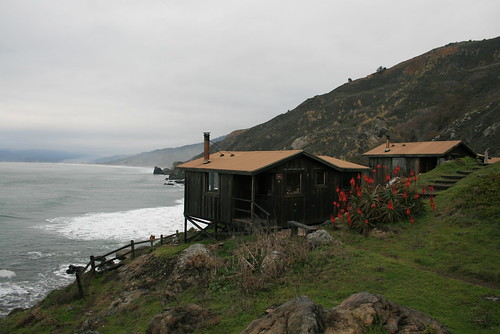
My sister, Nicole, and her husband, Marcel, came for a quick visit this past week and as a special treat, we reserved one of the Steep Ravine Environmental Camp cabins on the ocean! They are part of Mt. Tamalpais State Park, which is located just north of San Fransisco in Marin county. The cabin was a bit pricey ($100/night) but we figured it would be a once-in-a-lifetime kind of experience, and where else can you get a beautiful cabin just a stone's throw away from the ocean for $100? Split between four people, it wasn't bad. We reserved it on recreation.gov.


Steep Ravine Cabin
Two of the Steep Ravine cabins perched on 'rocky point.'


When we reserved the cabins, we got an e-mail with the code to the gate (the entrance to the environmental camp is locked from the highway) and the combo for the cabin. You must make a reservation to get in - its not a drive-in kind of campground. We reserved cabin #4, which was the southern most cabin, and we had an awesome view of the waves crashing onto the rocky shore. Before I reserved the cabin, I tried researching about them on the internet, but couldn't find too much info on them, so I will write as much as I can about our experience.


Steep Ravine Cabin
Our cabin, called Rocky Point, #4.


Inside the cabin, we found a plaque which told the history of the cabins. They were built in the 1930s by some man (I forgot who). He built 13 of them and then leased them out to private individuals. In the 60s or 70s, the state park took over the land, and the issue with what to do about the cabins became controversial. They were abandoned by the park service, and most of them became dilapidated. Three of them eventually had to be torn down because they were in bad shape. In the 80s, the park finally began to restore them, and in 1984, they began renting them out to people to stay in (like us!). There are 10 cabins which remain in use, plus a fancy campground host cabin (it looks more like a small house). There is no running water or electricity. It is completely primitive. Inside the cabins are wooden sleeping platforms and a wood stove, which you use for heating.


Steep Ravine Cabin
The smaller of the two sleeping platforms in the 'bedroom.' You can also see the bunk beds to the right.


We came with a bunch of our own firewood (although they sell large bundles for a reasonable price near the campground host). We also had a big Coleman lantern to light up the cabin at night. We brought all of our camping stuff, basically, like sleeping bags, a small stove, and the mess kit.


Steep Ravine Cabin
The table and bench/sleeping platform in the main room of the cabin.


We got there in the afternoon, so we had time for a small hike before it got dark. There was a nice trail along the coast, and also into the campground part of the environmental camp. We saw calla lilies blooming and other coastal flowers in bloom. There were hummingbirds, herons, and pelicans all over! After that we ended up going back into the cabin to start a fire in the wood stove and toast some pine cones we picked up so that we could eat the pine nuts. We ended up over-toasting them, because they came out a little burnt.


Steep Ravine Cabin
Ocean view from inside the cabin (#4).


We brought plenty of wine and chips, chili, avocados for dip, and cheese. That was our dinner. We could hear the waves crashing into the shore below us all evening and all night. It was neat! Although it was cloudy, it didn't rain. We had a light mist overnight, but we were sleeping anyways.


Tidepools
Tidepools near the cabin.


The next morning, we woke up early so that we could go check out the tidepools near the cabin. Hiking north, we found a rocky inlet where we saw a bunch of hermit crabs in their shells, walking around. Then we began to notice bright green sea anemones, and even brown and orange starfish! We picked up some dried kelp, and tried poking the starfish to see if they would move, but they were really hard and stiff, and they didn't even budge. They were just stuck to their rock.


Starfish
A brown-ish starfish at the tidepools.


Starfish at the Tidepools
Two orange and two brown starfish clinging under the rocks.


Sea Anemone
A green sea anemone.


On our way back, the sun came out a little bit, and we saw a rainbow! But it seemed like rain was coming our way. After we got back to our cabin, it was sadly time to go already, since check-out was at noon. So we packed up our things and headed to the car. We drove home along the coast on Hwy 1.


Rainbow over the Cabins
The Steep Ravine cabins and a rainbow.

Tuesday, December 01, 2009

Bristlecone Pines: Earth's Oldest Living Things!

Whenever we make a trip over to the Bishop, CA area, we have to stop and see the Bristlecone Pine trees. They live happily in this one spot (although their range extends into Nevada and Utah), high up on the mountain tops in the White Mountain Range in east central California, just north of Death Valley National Park. The White Mountains are in the rain shadow of the Sierra Nevadas, so they are extremely dry and cold, but just as high! The tallest peak in the Sierra Nevadas (Mt. Whitney) stands at 14,525 ft, while the tallest peak in the White Mountains (White Mountain) stands at 14,246 ft.


Bus at 10,000ft
Driving up to see the Bristlecone Pines over Thanksgiving 2009. My mom is scrapping off the ice build-up on the windshield. The Bristlecone Pine forest is in the background.


The Bristlecone Pines live up there, just below the tree line. They survive in the dry, windy, and cold environment because they grow very slowly and their wood is highly resistant to insects, fungi, and disease. The oldest known tree living right now is 4,767 years old and is named "Methuselah." It grows somewhere up in the Ancient Bristlecone Pine Forest, a protected region up in the White Mountains. Its exact location is kept secret to protect it. To give you an idea of how old that actually is, Methuselah was a seedling when the ancient Egyptians began building pyramids. It is still alive today!


Bristlecone Pine
A Bristlecone Pine in the White Mountains.


The White Mountain Range is home to the oldest Bristlecone Pines. Scientists who read tree rings have made a continuous record of the pine trees' growth that goes back 10,000 years ago by coring dead trees and alive ones. This website is a great place to learn more about them!


Bristlecone Pine
A close-up view of the twisted branches of a Bristlecone Pine in the White Mountains.

Monday, November 30, 2009

Calpine Fire Lookout Tower

For the Thanksgiving break this year, my mom visited from Chicago. Having Thursday and Friday off from school, we decided to take my mom to the Sierra Nevada mountains because she never saw them before. A couple weeks in advance, I reserved an old fire tower in the mountains north of Lake Tahoe to spend Thanksgiving night in. The National Forest Service used to staff hundreds of fire towers which were built on the tops of mountains all throughout the West. The towers were staffed (some still are staffed) during the summer months, when lightening storms threatened the forests with wildfires. But in modern times, many places watch out for fires using airplanes instead, so the fire towers became obsolete. Now the Forest Service rents out some of the towers to the public at reasonable prices. You can reserve them online at recreation.gov or directly from the nearest ranger station, and most National Forest websites have a page about the towers they rent out, if there are any.


Calpine Lookout Tower
The Calpine fire lookout tower we spent Thanksgiving evening/night in.

Calpine Lookout Tower
View of Sierra Valley from the Calpine fire lookout tower.


The road to the Calpine fire lookout tower was gated, so before heading there we had to stop at the Sierraville Ranger Station to pick up the gate lock combination and the lock combination for the tower itself. Since it was Thanksgiving day, they left us a small packet of info in a black mailbox outside the station. It gave us info and directions to the tower, which was just across the Sierra Valley. There was still snow on the ground from the snow storm they had a week before, but the road to the tower was still open. When we got to the road, it had compacted snow from where people drove before which had turned icy. The parts of the dirt road which were exposed to the sun were pretty muddy. We decided it would be best to just put the chains on the tires so that we had more traction. It wasn't too hard to put the chains on, and it made driving much easier and safer.


Road to Calpine Lookout Tower
The chains are on the bus.

Gate to Calpine Lookout Tower
Locked gate to the tower.


We brought everything with us that night to cook our own Thanksgiving dinner for three. Since a turkey would be too big, we got cornish hens, veggies & potatoes, cream of broccoli soup, and cake for dessert (although we ended up eating it for breakfast the next morning instead). The tower had a propane stove and oven, along with a propane heater, and sink, but no running water. We brought our own 7 gallon container filled with tap water up to the tower, which was plenty. As the sun began to set over the mountains, we put the food in the oven to bake while we had some soup and drinks. The tower had a deck of cards, and so many books to read. We relaxed, watching the sunset over the mountains, and just enjoyed the scenery.


Calpine Lookout Tower
The beds in the fire tower.

Calpine Lookout Tower
The sink in the fire tower (BYO water).

Calpine Lookout Tower
Evening at the Calpine fire lookout tower.

Thanksgiving Dinner at Calpine Lookout Tower
Thanksgiving dinner.

Calpine Lookout Tower
Night at the Calpine fire lookout tower.


That night, when we went to bed, we could see the moon shining, which provided a bunch of light, but made it hard to see the stars. After the moon set, the stars were bright. Sometime after midnight, we were all awoken by a crazy wind, which ripped over the mountains and shook the wooden awnings over the windows. Sometimes the wind blew so hard, it felt like the whole tower was shaking! The wind came in gusts, which were becoming more and more frequent as dawn approached. Being surrounded by windows, when the sun came up it was hard not to wake up, with all the natural light beaming in. By that time, the wind was constantly blowing and it looked as if a snow storm was headed our way from the West. So we got our things packed and made coffee and had breakfast, and then started making our way out of the tower. Our next destination was Lake Tahoe, for a quick drive along its eastern shore, and then we were off on Hwy 395 south to show my mom some natural hot springs. . .


Sunrise at Calpine Lookout Tower
Sunrise at the tower.

Monday, November 23, 2009

VW Campout at Bothe Napa State Park

The weekend before Thanksgiving, the vwcamperfamily (which, by the way, has a *new* website - check out the link) organized another camping get together at the Bothe Napa Valley State Park campground, and the highlight of the whole campout was a Saturday night early Thanksgiving dinner. Everybody brought a small dish with them but the star of the show was Joel's turkey deep fryer and Melissa's big turkey. There were over 10 buses that showed up, a great turn out! Here are some pictures I took over the weekend:


Bothe Napa Valley VW CampOut
Our orange bus and John's dormobile bus shared a site to save a little money on the camping fees.

Bothe Napa Valley VW CampOut
Sheri and Mike's split window bus, and Brett's Big Blue bus.

Bothe Napa Valley VW CampOut
Joel puts the turkey in the deep fryer to cook.

Bothe Napa Valley VW CampOut
The turkey looks done and ready to eat! Gobble gobble!

Bothe Napa Valley VW CampOut
Waiting for all the food to cook. Hanging out by the camp fire under John's big tent.

Sunday, November 15, 2009

Update on my Yurt

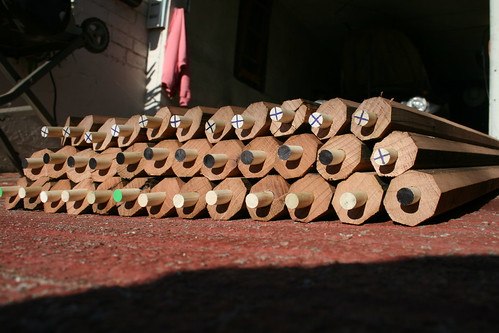
I spent this weekend working on my yurt again. I got a lot done, and I'm really happy about that! But I've also been working on it sporadically during the past few weeks after I get home from school. After I finished putting together the crown, I sanded it down to even all of the jumps out of the wood, then filled in the holes and gaps. I got a type of wood putty that resembled tile grout, but it was light brown. It was hard putting the putty into the gaps, since it was very course and sandy (not like putty at all) and at first I was really upset at myself for not opening the little bottle up at the store to check its consistency. But the stuff dried very fast, and sanded down well, and didn't crack or anything yet. So overall I'm pretty happy with how the grout/putty turned out.


Sealing the Yurt Crown
I am sealing the crown after I sanded and puttied it.


Since last time, I decided to paint the crown in a traditional Mongolian design, bright red, orange, blues, pinks, and yellows. That is why I am sealing it instead of varnishing it, because I will paint right over it in the next few weeks. Come to think of it, I may hold off on painting it until I finish the frame of the yurt and put it up once as a test.

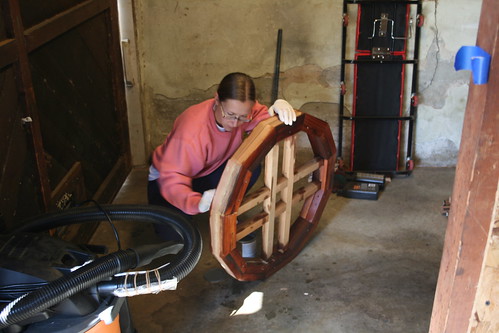
After the wood sealer was dry on the crown, I drilled holes into it for the 36 roof poles to slide into. The roof angle is 30 degrees, so all of the holes had to be drilled at an angle, and made for quite a hard time fighting with the drill press. One hand was turning the wheel to bring the drill down, the other hand was holding the angle finder to make sure I was drilling at the correct angle, and both my legs were bent, supporting the wheel securely. Too bad Romy wasn't there to take a picture. I must of looked funny!


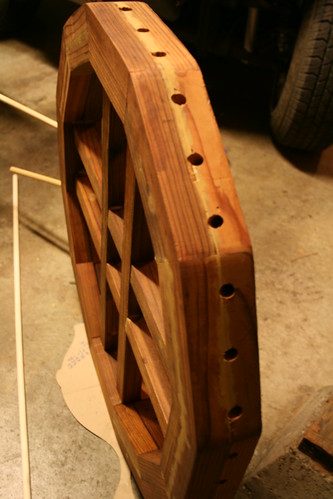
Yurt Crown with Drilled Holes
The yurt crown with 36 holes drilled into it.


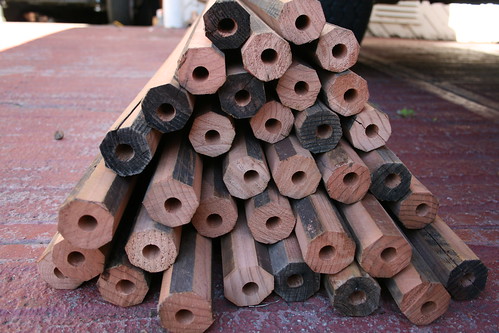
The crown now is basically finished, except for some decorative touches (like the painting and some bowed sticks I will add later to support the rain dome). So next I moved on to finish the roof poles. Since they were still rough (all I did last time was round them out), I had to cut each of them to 6 ft. This wasn't too hard, but it was time consuming. Some ends were split, so those were the ends I cut off. Other ends had knots in them, so I also chose to cut those off too.


Yurt Poles Cut to 6ft
All 36 roof poles are now 6 ft long.


To attach the roof poles to the crown, I decided to go with a 3 inch long dowel pin that is 1/2 inch thick. I cut those to size from a long dowel rod I bought at OSH (a hardware store). That was much cheaper than ordering real fluted dowel pins from a supplier. I only needed about 40 dowel pins, but usually large dowel pins like that are sold in bags of 100! Anyways, 2 inches of the dowel pin goes inside the end of the poles, and 1 inch will stick into the crown. The dowel pins are now part of the roof poles. But to make drilling easier for myself, I first drilled a 2.5 inch deep hole into one end of each pole (1/2 inch thick) and then cut the same end off each pole at an angle, to accommodate the slope of the roof. In the process, about 1/2 and inch was sheared off, which is why I had to drill the hole 2.5 inches deep at first instead of 2 inches. It is much easier to drill into a perpendicular surface than into one that is angled at 30 degrees!


Yurt Poles with Holes
The holes for the dowel pins are drilled into each end of the yurt roof poles.


As an added complication, since the yurt crown is a polygon instead of a true circle, some of the poles come at an angle to the crown (I'm not talking about the angle of the roof slope). There is only one roof pole per polygon side that comes in straight on, and that's the one right in the middle of each polygon section. The other two come in at opposing 10 degree angles. So I had to cut each pole either straight on with a 30 degree slant, or +10 degrees with a 30 degree slope, or -10 degrees with a 30 degree slope. Consequently, I labeled the end of each pole so that it will be easier to build it.


Yurt Poles with Dowels
Each roof pole is labeled and cut with its corresponding angle.


I also cut a notch into the other end of the poles for the wall attachment, but I will save explaining that for another post.

Tuesday, November 10, 2009

Natural Hot Springs of the Eastern Sierra

We first heard of the secret natural hot springs in California a few weeks ago when our friend from the vwcamperfamily group, Melissa, told everyone at the Ocean Cove camp-out about a place she went to on the eastern side of the Sierra Nevada mountains. Up on the mountainside, she said she found a place called Buckeye Hot Springs where she dipped in a hot creek, a geothermally heated source of water which drained down the slope creating a creek. Local people in the past made small hot tub-sized pools to retain some of the hot water so that it is nice and convenient to sit and bathe or soak in the nature. After she told us about this place, she pulled out a book which was a sort of guide to Buckeye and 100 other natural hot springs, most of them along the eastern Sierras and in the state of Nevada. We bought our own copy when we got home after that weekend off Amazon.com, and it arrived at our door the next week. We were ready to go find some of those secret soaking spots ourselves!

The Sierra Nevada
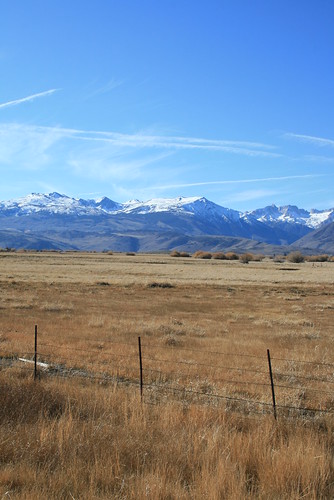
The eastern Sierra Nevada from Hwy 395


We intended to go last weekend, but the bus was having issues staying running, so we waited until my birthday weekend to go. All week Romy fixed up the bus and we cleaned and got it ready for the big trip over the mountains. We left Friday afternoon from Oakland, and our goal was to make it to Reno by dinnertime for a cheap prime rib dinner special at the Cal-Neva. We've been there before with Nicole and Marcel, so we knew it was good. We got so much food for so little money! We ended up packing half of it up in a doggie bag and stuffed it in the fridge inside the bus. Then we continued driving south to Carson City. We were looking for a place to sleep, and we remembered that in Carson City there was a 24 hour Wal-Mart on the south end of town. It ended up being extremely quiet and there were plenty of spots off to the side of the parking lot which were dimly lit and level. For those of you who have never tried it, 24 hour Wal-Marts are a great way to go stealth camping (but not in a tent, of course)!

Shepherd's Hot Spring
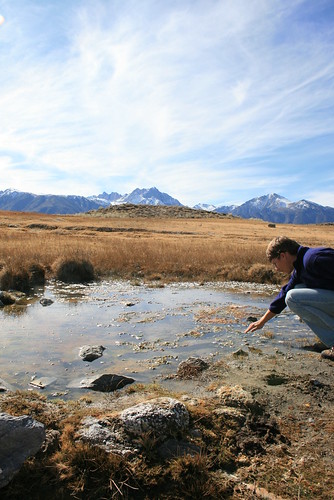
Romy is testing the water temperature of the source of Shepherd's hot spring.


The next morning we woke up and hit the road. Many of the hot springs we wanted to visit were near the Mammoth Lakes area, a big ski resort and summer recreation place on the eastern Sierras. My favorite part about the eastern Sierras are how, after steadily climbing higher and higher from the west, they seem to plunge down back to earth dramatically, creating a tall wall of jagged peaks. To the east lie a chain of valleys (still at high elevation, roughly 5,000ft on average) and further east rise even more peaks which continue on into Nevada. In the long narrow valleys, there are many natural hot springs, formed when water, which percolates down into the earth, is heated from within and is forced to rise back up through cracks in the earth's surface. Some hot springs are spewing hot water than once fell as rain thousands of years ago! When you bathe in these natural springs, its like you are bathing back in time.

Shepherd's Hot Spring
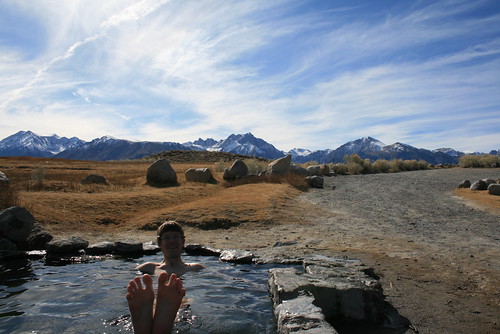
Romy soaking in the tub at Shepherd's hot springs.


Most of the natural hot springs are located on public lands, so anyone can go and soak in them, as long as you can find them. Each have their own source, the spot where the hot water comes out of the ground (usually very hot). Like in Buckeye, in the past, some local people created tubs, usually out of rocks and concrete, and plumbed in the hot water from the source to the tub by PVC pipe or simply digging a small ditch which channels hot water into the tub. All are very primitive, but they are wild and free. Developed resorts and spas basically do the same thing, except they build a fancy building and large swimming pools, and charge a lot of money to go swim in "their" hot spring fed pools. It almost seems silly after visiting and soaking in the natural springs because you are so far removed from the natural phenomenon. It is hard to tell if you are swimming in a heated pool, or if the pool is really fed by the hot spring. Swimming at a resort looses its ambiance a little.

The Crab Cooker Hot Spring
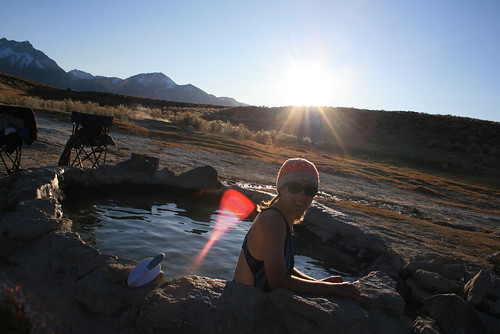
Jenn in the Crab Cooker as the sun sets.


The first hot spring we went to was called Shepherd's hot spring. Supposedly, some shepherds from the valley built the tub out of rock and concrete, so it was named after them. The tub was a little green, with algae stuck to the sides. It needed to be scrubbed out, but it wasn't horrible. The algae is not harmful. The second hot spring we went to towards the afternoon was not too far away, about a quarter mile to the south. It was called the Crab Cooker, because the water at the source is so hot, you can literally cook crab in it! When we found the tub, it had been drained and scrubbed, so it was extremely clean (as clean as a rock and concrete tub can get in the great outdoors). We found the valve and opened it to let the hot water from the source flow in. The tub was within 30 feet or so of the source, so when it flowed into the tub, it was still crazy hot! It burned the flesh, so we had to wait almost 3 hours for the water to cool down once the tub was filled up. We jumped in right before sunset, to our relief, because as the sun dropped behind the mountains, the temperature started to plummet. We were toasty warm in the 105F water, while the air temperature was hovering just above freezing. And this hot spring had one of the best views of the mountains all around us!

Little Hot Creek
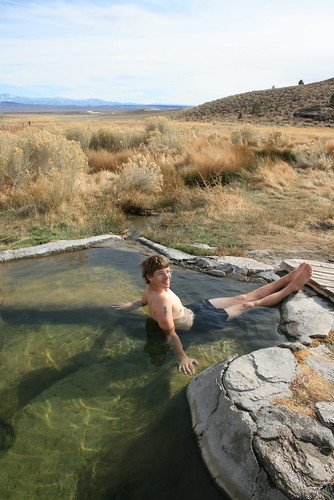
Romy relaxing in the tub at Little Hot Creek.


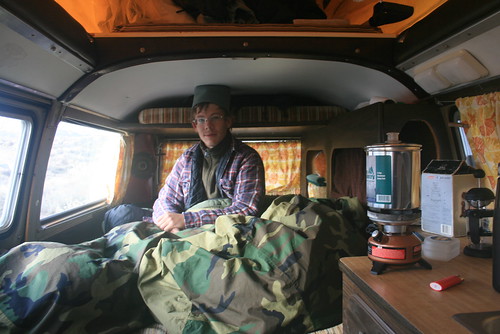
Being Saturday night, other people were also visiting the hot springs, so we were joined by a group of 4 people from the LA area. They stayed for a while, and we chatted in the tub, and before it got dark, they left. Me and Romy were left to watch the stars in the sky, and the milky way was right above us. When it was time to get out, we realized that it was really cold outside. . . our towels being moist from going in and out before were now frozen stiff in the shape that they were draped over the folding chairs! We quickly shook them out, dried off, and ran back to the bus. Since it was really cold, we pulled out the propane catalytic heater, but sadly found out that we were low on propane, so the heater was putting out minimal heat. So to warm up, we cooked some chili and jumped into the sleeping bags. It was well below freezing, but we were warm in the sleeping bags, finally.

Freezing Morning in the Bus
Making morning coffee in the bus.


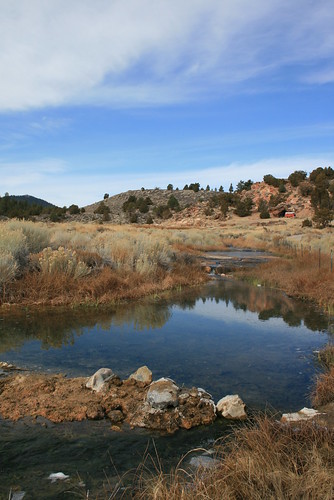
The next morning, after eating breakfast and making coffee, we searched for a hot spring that the people who joined us last night in the Crab Cooker told us about. It was called Little Hot Creek, and they said it was pretty secluded, far down a dirt road to the north. We headed that way and eventually found it, although it was pretty well hidden behind tall sage brush on the other side of the Little Hot Creek which was the source for the tub. There were also good camp spots right up the hillside.

Little Hot Creek
Little Hot Creek looks like a normal creek, but it is really warm!


After soaking in the Little Hot Creek tub, we moved on to see another famed hot spring called Wild Willy's. It was a short hike down a wooden boardwalk to the source of Wild Willy's. There used to be a man made tub there, but it was removed in order to restore the hot spring back to completely natural. But where the pool used to be, there was still a dug out area where people could bath, although the bottom is more "rough." We didn't swim here because we wanted to start heading back north towards Carson City again, to check out more hot springs in a different area. So far we stayed within a 10 miles radius and saw 6 different hot springs already!


Wild Willy's Hot Springs
The natural pool at Wild Willy's hot spring.


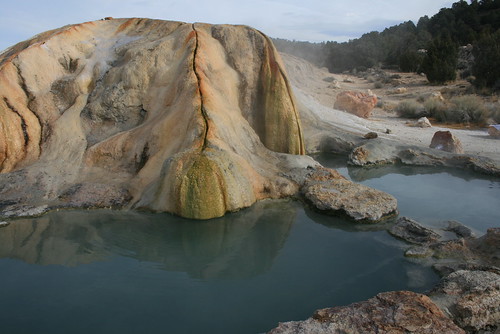
The last hot spring we visited was right out of the town of Bridgeport, California (the coldest place in California) and was the most popular. It was called Travertine hot springs, and was named after the travertine formations that form as minerals in the water are deposited (similar to stalagmites or stalactites). There were multiple sources at this hot spot, and there were 3 sets of pools dug out here. The most spectacular were right under the travertine, where locals carved tiny channels to flow into pools which had been recessed into the ground.

Travertine Hot Springs
The pools at Travertine hot springs.


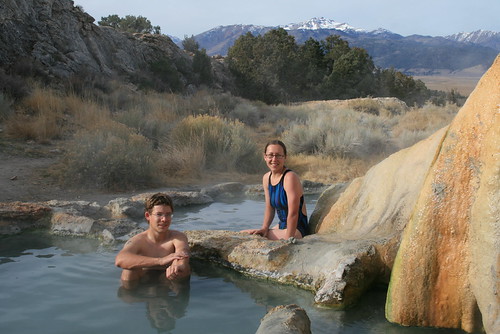
We met an interesting man named Lincoln and spent most of the night bathing and relaxing, talking to him, and other people (mostly locals who dropped in every once in a while all through the night). The temperature dropped pretty quickly, so we basically stayed in the pools were we were almost too hot at some times, even bringing our pots, pans, stove, and cutlery pool-side to cook dinner! As the sun dropped, the sky became bright with stars. There were so many shooting stars out, I couldn't believe it (it wasn't even during a meteor shower)! It was awesome!

Travertine Hot Springs
Romy and I at Travertine hot springs.


We finally convinced ourselves to get out of the pools at about 10pm or so, and we quickly jumped into our sleeping bags in the bus. That night was the coldest. The next morning, when we woke up, we made some coffee, poured it into our travel mugs, and hit the hot spring to warm up! I never enjoyed a morning cup of coffee in a better location (and it was my birthday!). A local who was walking his dogs walked by and started talking to us. He said that the overnight low was 15F, and that the area around Bridgeport had 10 times as many wild cougars as the rest of the state. I don't know if that was an exaggeration, but maybe. He also said that that morning was the annual cattle drive, where farmers and wanna-be cowboys drive cattle from the valley over the mountains into Nevada where they graze for the winter months. It started getting later and later in the morning, and we didn't want to leave, but sadly, we had to go back home that day. So out we went, dried off, and hopped back into the bus. We will be back!

Bus on CA203
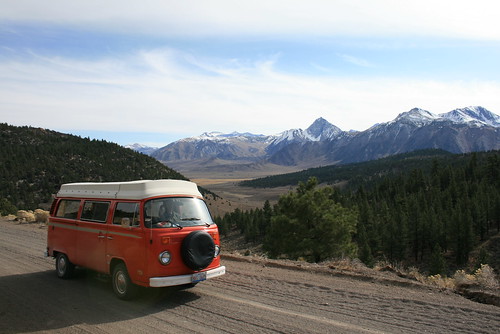
Headed home.