Thursday, May 12, 2011

The Buick Gets a Vinyl Top

While we were back home in Berwyn for Bobby and Julie's wedding on the 15th, Romy wanted to get a new vinyl roof put on the gold Buick. A few years ago, he got a completely new paint job, including body repair, and the vinyl roof was one of the last finishing touches to the exterior of the car. It was his grandma's car, and she bought it brand new in 1969 off the showroom floor and paid in cash. Romy took it to Ogden Top & Trim, a shop in Berwyn which specializes in doing custom upholstery and interiors of old cars. It turned out really nice! Not all the trim is on yet, because a few pieces are still missing (we suspect Scott must still have them somewhere, the guy who did the paint job). Here are some before and after pictures:

BEFORE (no vinyl roof):

Buick Vinyl Top

Buick Vinyl Top

Buick Vinyl Top


AFTER (brand new vinyl roof):

Buick Vinyl Top

Buick Vinyl Top

Buick Vinyl Top

Buick Vinyl Top

Buick Vinyl Top

Monday, May 02, 2011

Darwin Falls, a Real Oasis

Before we left Death Valley on this trip, we decided to check out Darwin Falls. The first time we attempted this was when Mark and Emma were visiting, and Mark was giving us directions on how to get the the falls. Instead of parking at the small parking lot, which was at the end of a 2 mile gravel road which followed a wash up towards the narrow canyon where the waterfalls are, we kept driving past it along one of the craziest mining road I've ever been on. It was called Zinc Hill Rd. That first attempt to go see the falls took us to China Springs, where Emma found a lush pool with a bunch of koi fish swimming happily in the middle of the desert next to an abandoned miner's house. This time, we read the directions and parked at the parking lot, which is the trail head to the falls.
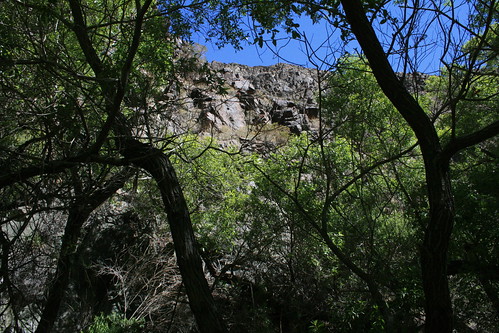
Darwin Falls
The surroundings start to get greener as we near the falls.


The trail starts out in the middle of a wash. It was pretty hot already even in the morning, and it seemed a strange place to start a hike into an oasis, since it was bone dry! But less than a quarter mile from where we parked, we started to see some vegetation. First some tall reed grasses, and then leafy bushes, small willows, and finally a forest of cottonwoods. Then we started to hear the quiet trickling of water as it flowed beneath our feet. The farther and farther we went, the greener everything started to become.
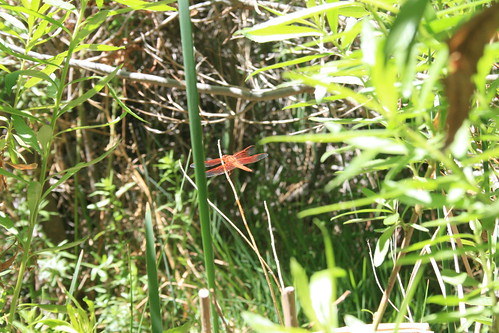
Red Dragonfly
A huge red dragonfly buzzed around us as we hiked towards the first waterfall.


As we entered the canyon, we started to see lots of flowers, many birds, and a lot more insects. We saw gigantic red dragonflys, lizards, and frogs. We were the only ones on the trail. The temperature was a lot cooler too, since everything was moist. As we hiked, we noticed some man made pools, which might still be used for a cool bath, but they were really overgrown and gross looking (even for our low standard).
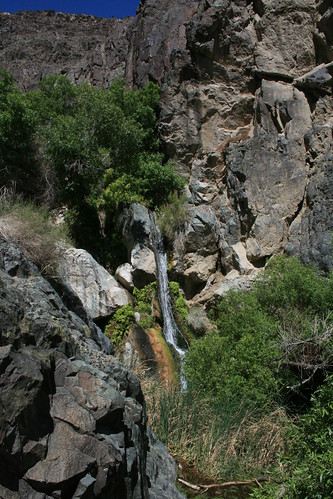
Darwin Falls #1
The first of nine waterfalls at Darwin Falls.


The trail involved a lot of water crossing, since almost the entire canyon bottom was filled with flowing or standing water. Mostly, the crossings were made by fallen logs and branches, or small slippery stepping stones. We both had sandals on, so it didn't matter if we stepped through some wet spots. It was nice to have some cool fresh water on my feet anyways.
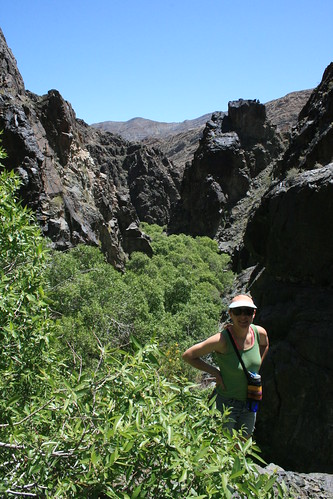
Darwin Falls
Hiking up and around the first waterfall.


Finally, after about a mile of total hiking so far, we reached the first waterfall. There are nine waterfalls in total. The first one was kind of hidden behind a lot of vegetation, so to see it entirely, we had to wade through some swampy area to get closer. The waterfall cascaded over a tall solid stone wall, and the only way past it to see the others was to go up and around it. Luckily, we had Mark's old guide book with us, which told us how to get past the first fall. When we read the directions, it was kind of vague. All it said was to look for a footpath up the steep canyon wall to the left of the falls, and proceed along the narrow ledges until you see a safe trail back down. When we looked for a footpath up, as described, there were actually many, so we picked one and followed it.
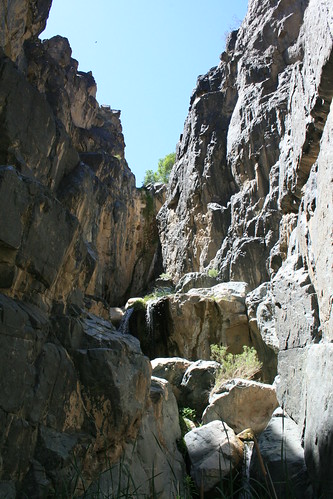
Darwin Falls #3 and #4
We found the third and fourth waterfalls!


I guess we picked a good enough trail, because it took us up and over the fall, along the canyon walls on ledges that were sometimes less than a foot wide (not the best place to slip!) From up top, we could see the tree tops which filled the bottom of the canyon with a bright green color, in contrast to the dark towering rock walls. We didn't know how far to keep traversing. We saw a few steep drop points that were 'safe' enough to down-climb back to the bottom of the canyon, so again, we just picked one and went for it. When we got to the bottom, under the thick canopy of trees, we found an overgrown trail, and a bright orange ribbon that somebody tied to a branch. I took that as a sign that we found the trail again!
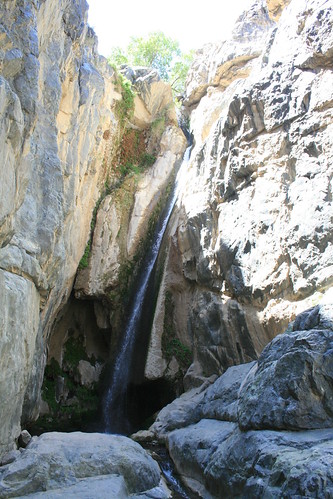
Darwin Falls #4
The fourth waterfall is the highest of the nine falls at 60 feet!


It wasn't very far to the second small waterfall, which was only 2 or 3 feet high. Getting around that was no big deal, and we continued on. Finally we got to the third which was a bit bigger. Behind that one, we could see the bottom of the fourth waterfall, which was roaring! This thing had to be big, but it was hidden from us by steep canyon walls. We were a little confused on how to get to it, and after trying to traverse a few parts of the walls in our clunky sandals, we gave up and looked at the book. It told us that we needed to go find a scree pathway to the right of the two falls. Half-way up the scree, we should see an opening in the canyon wall which would lead us to the top of the third waterfall, and to the base of the fourth.
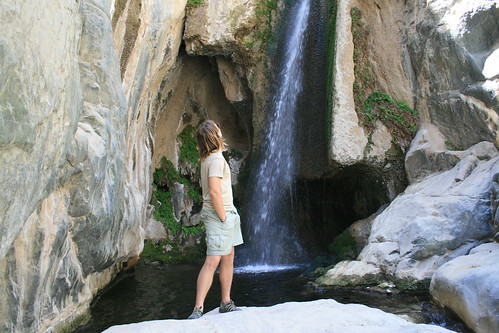
Darwin Falls #4
The bottom of the 4th waterfall.


We followed the scree pathway, as the guide book told us to, and there it was - a narrow opening through the wall which opened up to a grotto-like space where the fourth waterfall dropped 60 feet into a clear and deep pool! The pool water then cascaded past where we were standing, into a second more shallow pool filled with grasses. The water here then poured out into the third waterfall, which we were standing beneath just a few minutes ago. It was a little challenging hopping between the pools to get to the bottom of the fourth and tallest waterfall with our wet sandals. Once we got underneath it, the force of the water was so powerful! We tried putting our hands under it, and it smacked our hands down really hard. Good thing we didn't fall in under the churning water, because some of the moss covered rocks were slippery!
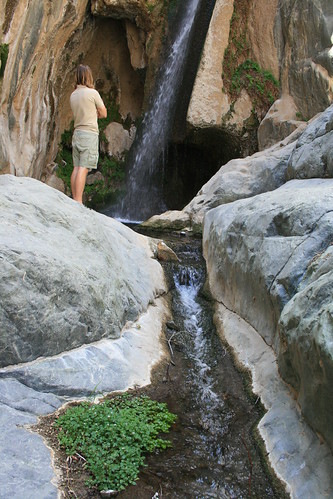
Darwin Falls #4
Water cascades from the 4th to the 3rd waterfall.


We decided to stay in the sun-filled grotto between the third and fourth waterfall for a long and relaxing lunch break. It was so amazing to find such an awesome waterfall, and the fact that it was in the middle of a desert made it even more spectacular. We didn't see a single person on our whole hike, which made it even cooler! I have a feeling that 95% of the people hiking the Darwin Falls trail stop at the first waterfall.
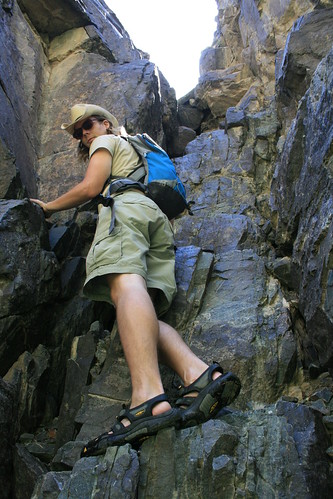
Romy Climbing up to the Falls
Part of the hike back took us along the high canyon walls.


After spending a few hours at Darwin Falls, we made our way back out towards the car, which was baking in the heat! What a different world we just came from.

Saturday, April 30, 2011

Exploring a Mountain Made of Borax

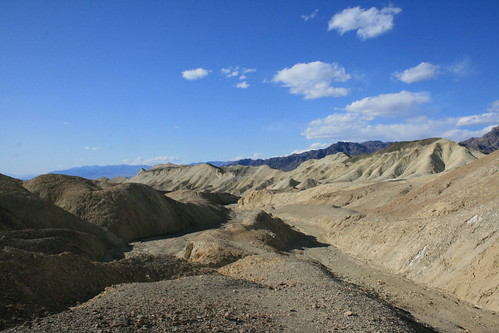
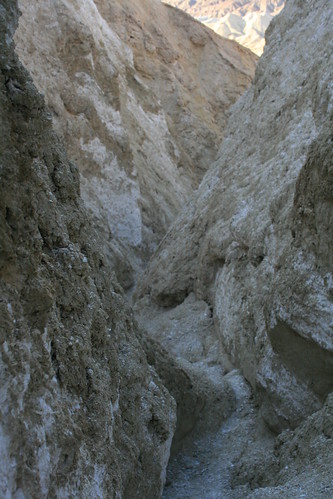
A trip to Death Valley is never without stumbling across references to the Twenty Mule Team and borax mining. This trip (which was sort of a trip where we decided to go explore all the places we missed over the past couple times we've been there) we went to check out what the Twenty Mule Team was all about. There is a short road called Twenty Mule Team Road which is a one-way, single lane road through the northern end of the Black Mountains, and it goes through the Death Valley badlands area. Its an area of quickly eroding, soft mud mountains which were actually once the bottom of a seasonal lake that existed a long, long time ago (before the mountains were uplifted).

Twenty Mule Team Canyon
Starting our hike at the old junction on Twenty Mule Team Rd.


Borax found in nature is an evaporite, meaning it crystallizes after evaporation of the solute it was dissolved in, in this case, after the seasonal lake dried up (multiple times over and over again in the past). Many deposits were created like this on the muddy bottom of the ancient seasonal lake. In modern day, the ancient lake bottom has been pushed up by tectonic processes and forms the soft muddy mountains, some of which have massive borax deposits mixed in the mud. Its really a neat thing to see, because the borax looks like a bunch of bright white streaks, like powdered sugar or something was sprinkled over and within the mountain.

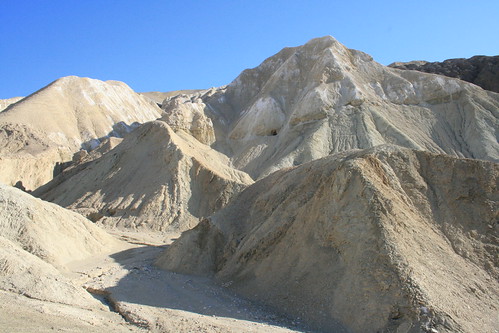
Monte Blanco
The famous Monte Blanco, a mountain made of borax! See all the white streaks?


In the late 1800s, the borax mining industry was booming, especially in the Death Valley area, although it was short-lived. I don't think that Monte Blanco was every mined to its full potential because of the difficulty of the site, but nearby deposits in Death Valley were. The Harmony Borax Works is the most famous of the companies that mined borax there. The way they did it was kind of interesting. As we were hiking, we noticed that a lot of the borax was interspersed with the dried mud deposits, so how were they able to get just the borax out and not all of the mud with it? At first we thought that maybe they just found gigantic or massive deposits of pure borax, but that was not the case (although there were probably larger deposits that we never saw deeper in the mountain).

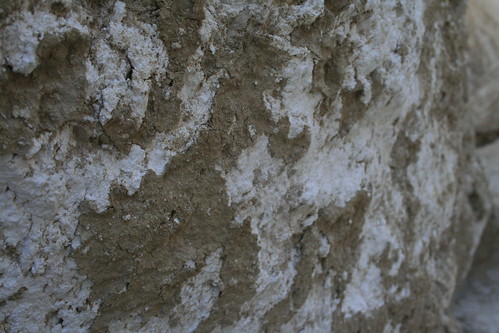
Borax
A close-up of borax deposits popping out of the muddy mountains.


What the miners did was first dig out a bunch of the borax and mud mix, and together, they then hauled it to a processing facility near present day Furnace Creek. There they dumped it into huge pools or tanks of water where they let the borax dissolve and the dirt settle to the bottom. They did this many times to purify the water, so that only the salts and borax were dissolved in it, and not the unwanted dirt. Then they used the knowledge that borax crystallizes at a certain temperature, so they put a bunch of rods into the tanks and cooled the water down. When the water hit the correct temperature, the rods would act as surfaces which allowed borax crystal to grow on them, and this is the way they were able to extract pure borax from the water. When the Harmony Borax Works was in full swing, it employed 40 men who produced three tons of borax daily! In the heat of the summer, when the water couldn't be cooled to a low enough temperature, they moved the operation to a cooler location, near Tecopa, CA instead of Furnace Creek.

Romy Hiking in Borax
Hiking up into the mud and borax narrows near Monte Blanco.


I'm still not sure what all borax is good for (but you can read about it online if you're interested). I think its mainly for cleaning and buffering certain solutions. I kind of remember hearing that when borax was in its early days of mining, the miners who wanted to make a profit on it had to invent uses for it and then try to market it, because borax wasn't used much before then. While we were hiking up towards Monte Blanco, we kept getting stuck in all kinds of narrows and dead ends. As we got through the tightest narrows, we kept rubbing against the sides of the canyon walls, which crumbled at the slightest touch. In fact, if there was a section of abundant borax deposits, it was like walking through slightly compacted powdered sugar! It was so soft, literally like powder, and we got a good dusting. Our socks (we wore sandals with socks) were completely soaking it up as we hiked, and we joked that when we rinsed them out that evening, they would be super clean from all the borax. But that didn't actually happen because I don't think borax by itself is really good for laundry, its just a laundry "booster" whatever that means.

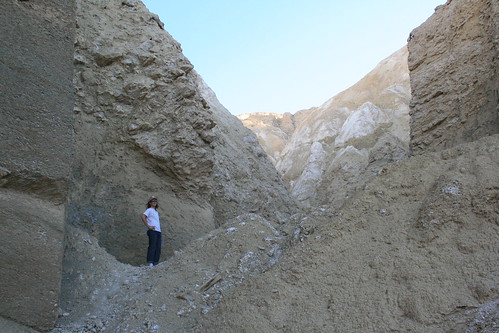
Twenty Mule Team Canyon
We squeezed through these narrows and got covered in mud and borax dust. The mountains just crumbled at the slightest touch.


The way the Twenty Mule Team got famous was due to the crazy trip that the miners devised to haul the final borax product out of Death Valley and to civilization. According to our hiking guide book, the Team never had any mishaps (no broken wagons, no dead mules), even though they were trekking over very rough territory. The team of twenty mules were able to haul 36 1/2 tons of borax and supplies each trip! Here is an excerpt from a great website that gives a much more detailed history of the Twenty Mule Team than I have room for here:

Chosen for their intelligence and ability to lead the others, the first two mules in the train were aptly called the "leaders." The next 10 mules were known as the "swing team," workers that did not need special training beyond responding to commands such as "stop" and "pull." Following the swing team came the "pointers," "sixes" and "eights" — the pairs specially trained to leap over the chain when the mule train turned a corner. These mules were trained to respond to commands by name. Swinging the team around a curve in a mountain pass tested both driver and team: one mistake could spell death for all. As the team started around a sharp curve, the chain tended to be pulled into a straight line between the lead mules and the wagon. To keep the chain going around the curve and not pull the team straight over the edge, some of the mules were ordered to leap the chain and pull at an angle away from the curve. These mules — the pointers, sixes and eights — would step along sideways until the corner had been turned. Swinging a curve successfully was an awesome demonstration of training and teamwork. Finally, the "wheelers" were the last pair in the train. These mules, or sometimes draft horses, were the largest and strongest of the pack animals.

Camping
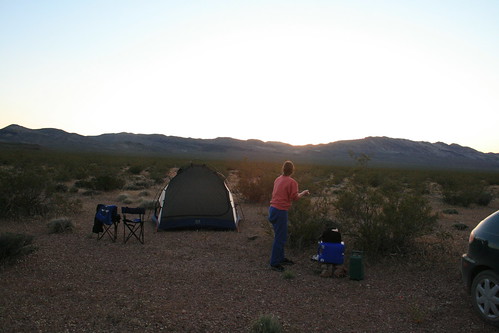
Our camping spot for the evening.


That evening, after hiking all afternoon around Monte Blanco, we drove up into the Greenwater Valley, which is just east of Badwater Basin. There we found a nicely graded gravel and dirt road called the Greenwater Valley road, and camping off of an offshoot road. It was nice and quiet, and we found a spot between the creosote bushes. That night, we camped with the small birds and lizards, and were surrounded by some late-in-the-season wildflowers, especially the apricot globemallows.

Saturday, April 23, 2011

Jellies and Seahorses

Today we went to the Monterey Bay Aquarium. Ever since we've moved to California, we've wanted to go, but it was one of those things that was always pushed aside whenever we had a free weekend. Finally we decided to go! There were many exhibits, but most seemed to be focused on displaying fish and other animals associated with the ocean, specifically the west coast. But they also had a seahorse and a jelly fish exhibit going on, and those were the most memorable. Here are some pictures:

Jellies
This is a purple striped jelly.


Jellies
This is an egg yolk jelly.


Jellies
This is a Pacific sea nettle jelly.


Jellies
A bunch of Pacific sea nettles floating around.


Jellies
These are spotted jellies, also known as lagoon jellies.


Sea Horses
This is a Leafy Sea Dragon. It is pretty big, about 1 foot long!


Sea Horses
Seahorses have great camouflage. Can you spot the seahorses in this picture? I can see 5 of them.

Friday, March 25, 2011

Crazy Mountain Chickadees

Even though it was spring break this past week, we decided to extend winter a little bit longer! After getting news of the non-stop snowfall that the Sierras were getting (and are still getting), we decided to go skiing and snowshoeing at Lake Tahoe.

Sierras
Technically, its the first week of spring, but it still looks like it's winter in Nevada!


On the first day of our trip, we went snowshoeing on the northwest side of the lake, in Nevada. We had a brochure of the Tahoe Rim Trail, a trail which you can hike (during summer) all the way around Lake Tahoe. We looked for a place where it intersected a main road (Hwy 431) and drove there to get on the trail (now under many feet of snow) to go snowshoeing. Usually, big trails like that have parking areas or large pull offs, so it was our best bet to find a parking place off the highway. When we got there, there were already a bunch of cars, so we knew it would be ok to park and leave the car. Once we got our snowshoes on, we headed off into a large meadow.

Icey Tree
The trees are frozen, covered by an icy snowy frost.


There were a few fresh snowshoe tracks and cross-country ski tracks. But none of them went directly across the open meadow. I wonder if its because people thought it might be a small snow covered frozen lake (which is what we thought a first), or if they just didn't want to disturb the open flat snow field with fresh tracks. After looking at it a while, we figured it couldn't be a lake, because the surface of the snow was tilted at an angle. I don't know of many lakes which have an angled surface ;-)

Frozen Branches
A close up of the frozen branches of a tree.


We didn't trek through the open field either. Instead, we headed off into the forest, where we climbed steadily uphill through snow covered pine trees. We heard many birds singing in the forest. When we took a water break, all of a sudden a bunch of small song birds flew around us and landed in the trees we were stopped next to. Some of them were very curious, and started swooping down at us, flying at our heads and straight towards our face! At first we thought that they were angry at us, so we moved on, thinking that we should have our water break next to another tree.

Frozen
Winter scenery!


So we trekked a bit farther, to another tree. But the birds kept following us. And they kept swooping and flying at our heads! What was going on?! Then Romy decided to start waving his pole at the birds, to see if they would attack the pole instead. They weren't afraid of the pole! Instead, they just flew and sat on it! Then Romy put out his arm to see if they would land and sit on his hand. To our amazement, they flew right into his open hand! They just did it for fun or something, because we didn't have any food or anything a bird would want, except a place to land.

Jenn 3.22.2011
Mountain Chickadees flying at and landing on me.


After the initial excitement of wild animals being all friendly, we decided we should keep moving, since we came here to go snowshoeing, and not bird watching. So we kept going, and soon found another snowshoe-er's tracks, which we followed, since breaking our own trail in the deep fresh snow was getting a little tiring! The trail started to climb pretty steeply, and after a while, we were getting so tired we decided to take a lunch break. We weren't used to all this physical activity at about 8,500 ft in elevation - we just came from sea level in Oakland!

Mountain Chickadee
A chickadee on my glove!


As soon as we sat down in the snow, the flock of chickadees were back. They followed us all this way! Now they weren't afraid at all anymore. They were landing on our heads, shoulders, hands, where ever! When we opened up our backpack, and took out our fruit and power bars, they were all over us. It was hard to eat, because as soon as you exposed a portion of your bar, there was a chickadee on your hand pecking at it. Maybe they are so friendly because they know hikers carry food! The weirdest thing was how crazy they were for our dried banana chips. They loved those more than our granola bars. Weird! After we were done eating, they still hung around, swarming us. It was a lot of fun being surrounded by them, singing and flying from one perch to another, but we were getting cold sitting in the snow, so we got up and started trekking further up the mountain.


A movie of chickadees landing on Romy's hands.


As we neared the top, we saw Lake Tahoe come into view below us. The wind started to blow and some of the snow clouds were clearing up over the Lake. We looked around to see if we could get to a higher place for a better view. Then we saw a distant small peak, which had a bunch of icy covered trees. We started heading for it. This time the slope was so steep, we had to put our heel bars up on the snowshoes so we could climb better. Finally we got to the top, and now we could see the whole of Lake Tahoe, around the whole shoreline! We didn't even know that we would be able to get this view when we started the trek!


A movie of chickadees invading our lunch break!


I guess we were really high up and pretty exposed, because the chickadees no longer followed us. All the trees were covered by a coating of frozen icy snowy frost that was wind blown onto all of the branches. It made the trees look really white and frosty. Since we were at the top, we decided to take a break before going back down. The sun started to come out and shine on us, so it wasn't that cold anymore. When we checked what time it was, we didn't realize it took us so long to get up there (since we took so many breaks to play with the birds). We decided it was best to start heading back down, since we still had to drive to our motel, which was in South Lake Tahoe.

Romy Snowshoeing Tahoe
A pic of Romy snowshoeing.


On the way down, we found the steepest way and ran down, trying to ski with our snowshoes. It was pretty hard to do, since the snowshoes don't easily slip and slide. It took us almost an hour to get back. When we returned to the lower elevations, we heard the chickadees singing again. We waved good bye to them, and headed towards the car. We'll never forget the crazy chickadees!

Thursday, March 10, 2011

Time To Get New Skis!

This year we made a promise to ourselves that we would try and go downhill skiing more often, since we haven't really went for the past three years! Partly that's because its kind of expensive, compared to cross-country (or back-country which is totally free), but partly its because Romy didn't bring his downhill skis when we moved, so renting them would make it even more expensive to go skiing!

China Peak
Sitting on the lift up the mountain.


Moreover, given that Romy's old skis were really really old, and he found them in the garbage, bringing them with didn't seem worth it. They were the old straight ski style. So we did some searching on Craigslist and found a used pair of skis and boots that weren't that old for pretty cheap. Actually, they were last year's rentals at some ski resort. The boots fit and the skis were the right size, so we bought them and decided to try them out this week.

China Peak
Going up the lift to the top of the mountain.


We had a coupon to go to China Peak for half price, which is near Fresno in the Sierra Nevada mountains next to a small lake. It is in the Sierra National Forest but operated with a permit. It was small and cheap, with lots of intermediate and easy runs, so it was the perfect place to try out the skis, not to mention go downhill skiing for the first time in three years!!!!

China Peak
The top of China Peak!


When we got there, it was so sunny and warm. We didn't even need hats, scarves, gloves, or eye goggles because there was no wind. It was like spring time skiing except it was still winter. For the first time, I was putting on sunscreen to go skiing. This was totally different then skiing in the midwest where it is usually so cold, that your face is totally covered by hat and scarf anyway, so no need for sunscreen. Except we totally forgot sunscreen, so we bought a little bottle from the store at the bottom of the lifts.

China Peak
View of Huntington Lake from the ski runs.


We really liked China Peak. It was a fun place to go because it was small, and the crowd seemed very local. A lot of college kids from Fresno, and families. There weren't any punk annoying snowboarders who sat in the middle of the run, or dug in deep ruts. Nothing like that.

China Peak
Sitting on the lift.


We rented a locker for 50 cent, where we stored our lunch and extra cloths. They were right outside, next to a bunch of picnic tables. We ate lunch outside because it was so warm in the sun.