Sunday, June 07, 2009

Volunteering to Build the Bay Area Ridge Trail

This past weekend I decided to volunteer to help build a new section of the Bay Area Ridge (BAR) Trail which, when finished, will be a continuous trail encircling the entire Bay Area. The section I worked on, along with over 100 other volunteers, was in Hercules, CA, in the north east bay area.

The current map of the Bay Area Ridge Trail. There are still many sections which need to be completed, as shown by the dotted line.

Not all of the land that the BAR Trail crosses was public. There are many private ranches around the bay area which are still privately owned. This isn't really a bad thing, since the ranches are usually hundreds of acres large and are not developed. It adds a open and wild feel to much of the hills around the bay. But since the ranches are privately owned, trails aren't allowed to be built across their land. Luckily, certain public land trusts raise money to try to buy these ranches, which the owning family usually ends up selling for millions of dollars to the land trusts. The land trusts then donate or pass on the property to the government, such as the East Bay Regional Park District, or keep the land open for public use. The Muir Heritage Land Trust bought the Fernandez Ranch in Hercules and is now beginning to open the land for public use. Thats how I ended up helping out to build a new connecting section of the BAR Trail there.

I volunteered with V-O-Cal, Volunteers for Outdoor California. They specialize in organizing large groups of volunteers for mobilization for projects around Northern California, such as building new trails, making new campgrounds, habitat restoration, and trail maintenance. They provide free camping spots at the project site, free meals and beer, and free showers. I could only stay for one day since I planned to go last minute, but it was still a lot of fun (and a lot of hard work)! Here are some pictures I took with my cell phone:

This is a typical view of the rolling hills of Fernandez Ranch where the trail was cut. Most of it was routed through the forested parts.


The breakfast/lunch/beer tent for volunteers.


My group's section of the trail to be cut was on a slope.


The first step in cutting out our section of the trail was to clear the grass and plants off the surface.


Next, we started digging into the earth to cut a wedge out of the side of the hill. We aimed at making the trail 4 feet wide.


The trail finished after the first day of work. The day after I left, the rest of my group finished it off by smoothing out bumps and removing loose dirt that was thrown down the slope.

Sunday, May 24, 2009

Bug-o-Rama #63

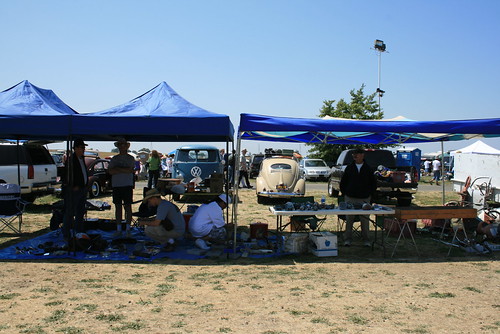
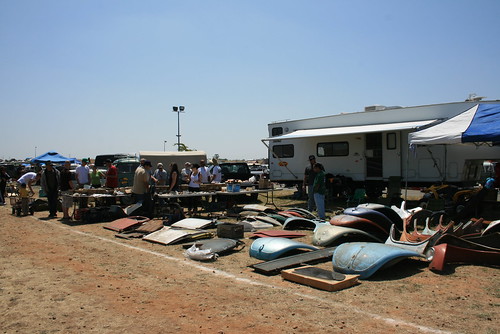
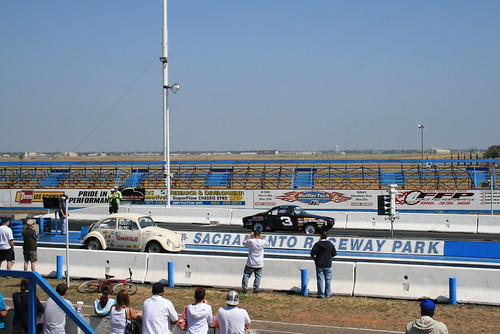
This weekend was Bug-o-Rama #63 held at the Sacramento Raceway. We drove down there mainly to see the VW car show and browse the swap meet. It was pretty nice outside, in the 80s and sunny. The swap meet was huge and people had all kinds of parts for all types of VWs but mainly bugs. We found a few things that we needed here and there.

Bug-o-Rama Swap Meet
People selling stuff at the swap meet.


Bug-o-Rama Swap Meet


Bug-o-Rama
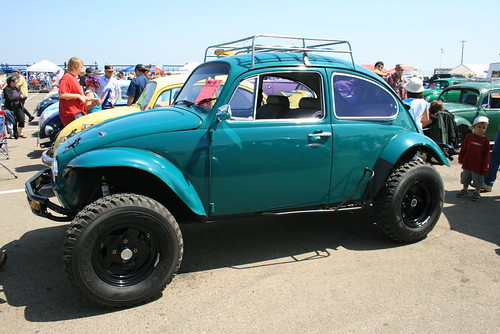
A cool baja bug at the car show.


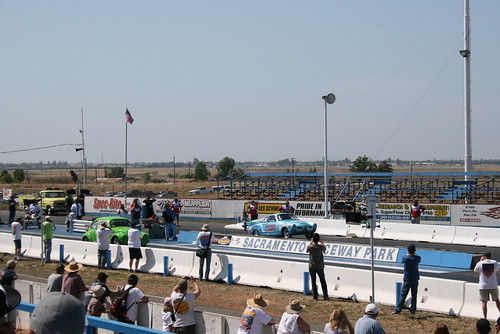
There was also a race, and many bugs were racing on the 1/4 mile strip. Many were heavily modified, but some were stock/original, and of course, they were really slow! They even had dragsters that just barely qualified to be a "VW" only because they were somehow aircooled or had some VW engine parts in them.

Bug-o-Rama


Bug-o-Rama

Monday, May 18, 2009

NSF Honorable Mention


Today, after much waiting and torture we were notified by the NSF that we both (!) received the Honorable Mention for the 2009 NSF GRFP. That means we didn't win any money, but at least we got recognized! Our names are listed on the NSF's list of awardees for 2009. Here is the e-mail I got:

Dear Jennifer Frederick:

Your application for the 2009 National Science Foundation (NSF)
Graduate Research Fellowship Program (GRFP) has been evaluated.
Although the Foundation is unable to offer you a fellowship, it
is my pleasure to inform you that you have been accorded an
Honorable Mention. Unless you have previously requested
otherwise, your name will be included in the Honorable Mention
list that will be posted at https://www.fastlane.nsf.gov/grfp/.

Applicants receiving Honorable Mention are provided enhanced
access to cyberinfrastructure resources, including supercomputing
time, through the TeraGrid. Please refer to
http://www.teragrid.org for more information on
cyberinfrastructure resources.

If you have questions concerning this notification, please send
an e-mail to info@nsfgrfp.org. Thank you for your interest in the
Graduate Research Fellowship Program. We wish you well in your
future studies.

Sincerely,


Carol Van Hartesveldt, Ph.D.
Acting Division Director
Division of Graduate Education

Monday, April 27, 2009

The Dalai Lama Came to Berkeley

So on Saturday, we had tickets to go see the Dalai Lama. He came to UC Berkeley to give a talk titled "Peace Through Compassion." In March, we waited in line a total of about 14 hours to just have the opportunity to buy tickets when they went on sale at the UCB box office. It was worth it. Since we couldn't take pictures, I am posting an online news article from UC Berkeley's website:
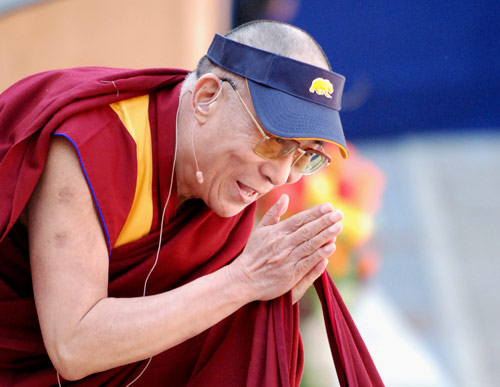

Dalai Lama
The Dalai Lama at the Greek Theatre
(Peg Skorpinski photo)


Dalai Lama: Creating a peaceful 21st century will take all 6 billion of us


, NewsCenter | 27 April 2009


Whether history remembers the 21st century as happy or unhappy "is in your hands," the 14th Dalai Lama, Tenzin Gyatso, told the students at his much-anticipated campus appearance Saturday afternoon. "My generation belongs to the 20th century. You are the source of hope."


More than 7,000 people filled UC Berkeley's Hearst Greek Theatre to see and to hear the widely revered Dalai Lama, who spoke for close to an hour on the theme of "Peace Through Compassion." The exiled leader of Buddhist Tibet was awarded the 1989 Nobel Peace Prize for his long-standing advocacy of peaceful solutions to conflict. It was his reputation as a force for peace that was on many people's minds as they waited under a clear spring sky for the Dalai Lama to appear on stage.


"I'm definitely a peacenik; he represents peaceful solutions to me," said Susie Sheridan, payroll supervisor for Information Services & Technology. Tsering Khangtetsang, whose parents fled Tibet at mid-century in the wake of the Chinese crackdown, was there with her sister Tenzin. The two had seen His Holiness numerous times before, and they planned to catch his address to Himalayans, in downtown Berkeley, immediately following his appearance at the Greek. "Our leader is the only one who says do not fight violently; do not go to war," said Tsering.
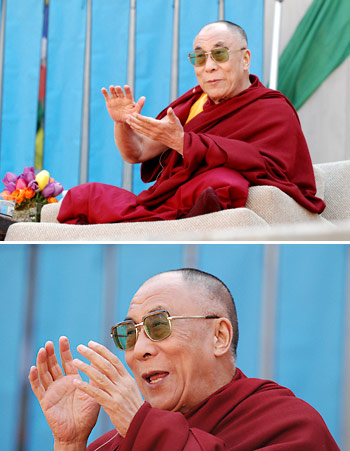

Dalai Lama(Peg Skorpinski photos)

Berkeley undergraduates were there in force — many having braved an overnight line to secure a ticket, back in early March; a large contingent hailed from the campus's Richard C. Blum Center for Developing Economies. Among them was fourth-year student Rachel Bramwell and fellow urban-studies major Matt Pruter. Both have done fieldwork in the developing world (she in Nairobi, he in Mumbai) as part of their studies on global poverty. "I'm here for him to tell us to become global citizens in the world," Pruter said of the Dalai Lama.


His Holiness did not disappoint. Sitting cross-legged in an armchair on the proscenium, beneath strings of fluttering Tibetan prayer flags, the 73-year-old monk called for conscious development of our human capacity for compassion. "Peace does not equal absence of problems," he said. Peace is when, despite "disagreement and the possibility for open conflict," people exercise restraint and will power to "seek ways to solve it" without coming to blows.


While the Dalai Lama touched on Buddhist understandings of reality, on animal behavior, and the mind-body connection, his signature humility and comic timing were in play, in spontaneous asides on his childhood aversion to caterpillars and his difficulty finding the right words in English. ("As I become older, my English becomes older," he declared.) One visitor, Associate Professor of Public Policy Jane Mauldon, described His Holiness as "extraordinarily available, disarmingly human, and very intimate."


It was the Dalai Lama's second appearance at the Greek Theatre, his third at UC Berkeley (he visited in 1997 and 1994). He was introduced by Chancellor Robert Birgeneau and by actress Sharon Stone, a board member of the American Himalayan Foundation, which co-sponsored the event with the Blum Center.


Prior to the talk and in the presence of the Dalai Lama, Birgeneau presented Blum, a Cal alum and chair of the UC Board of Regents, with the campus's highest award, the Berkeley Medal, in honor of his contributions to the campus and the university. The chancellor noted that he had bestowed a Berkeley Medal just two days before, on former vice president Al Gore, during a groundbreaking ceremony for the Blum Center's new headquarters. Blum, an investment banker and husband to Senator Dianne Feinstein, established the Center for Developing Economies in 2006 with a $15 million gift.


In accepting the Berkeley Medal, Blum called the day "a merger of the two things I care most about: UC and the Tibetan people and their plight."


Only a month ago, on the 50th anniversary of China's crackdown on Tibet, the Dalai Lama sharply criticized the People's Republic of China, saying its leaders had turned Tibet into a "hell on Earth" for the Tibetan people. It was Blum — who became interested in the Tibetan cause in the 1960s and founded the American Himalayan Foundation — who uttered the only strongly worded criticism of the Chinese government at the Greek. "If they want to become a great nation," he said, they "also need to become a moral nation. What goes on in Tibet is just immoral."


The Dalai Lama ended his 2009 appearance at Berkeley on a high note — pulling from his cloth bag a blue and gold Cal visor, and donning it as the crowd sent him out with a final standing ovation.
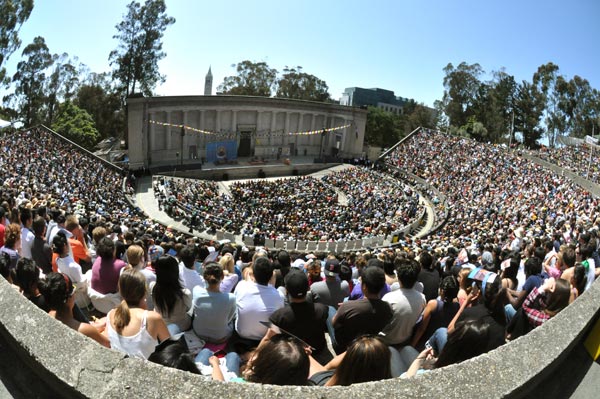


Greek Theatre crowdThe full house at the Greek Theatre. (Peg Skorpinski photo)

Wednesday, April 22, 2009

My Ancient Ancestors - Part I

My mom's (and mine too) genographic journey out of (and then back into) Africa. Follow the red lines/arrows.

Above is my mitochondrian genetic journey, a journey of my maternal lineage, which was uncovered with the National Geographic Genographic Project. It was traced by analyzing my mom's mitochondrial DNA (mtDNA), which is different than the normal DNA which encodes our body. Normal DNA is found in every cell (almost) and it comes half from your father and half from your mother. But mtDNA is different, and is completely separate. It is found only in the mitochondria, a cellular organelle which functions to produce energy for the body (it burns sugar and turns it into energy we use everyday to live and keeps us warm). Mitochondria are found in many cells in your body. mtDNA doesn't look like normal DNA either. It resembles bacterial DNA. That's because it is bacterial DNA. Millions of years ago, a bacterial cell was taken in by a eukaryotic cell (ie animal or plant cell). Somehow the bacteria survived inside of the cell, and eventually became a permanent part of it. It is believed that it may have provided needed energy for the cell. In the modern world today, all that is left of that bacteria is its DNA, called mtDNA, which resides in the cellular organelle called the mitochondria.

The mtDNA has a slow mutation rate. It will randomly mutate once every X amount of years, and then get passed down. Scientists can track its mutations by analyzing these changes in the mtDNA sequence. Since we know the rate that it mutates, we can use it to look back in time and use it to track our ancestral lineages. For example, when comparing a sample of people, the mutations that are most common between all of the people must have happened long time ago from a common ancestor. We know how long ago that ancestor might have lived because we know the mutation rate. Once tribes of people started branching off from each other, they developed distinct and separate mutations. So in a sample of people, the mutations that are least common between the group are probably the most recent. Organizing all of these mutations from a large sample of people's mtDNA sequences can lay out a map of human genographics, especially if the samples come from people who have lived in isolated areas of the world for a long time.

My mom's mtDNA sequence.

The mtDNA sequence is very short (only 569 letters) compared to the amount of "letters" in normal DNA, which exceeds billions. As you can see, the amount of letters in my mom's mtDNA can all fit in that small picture (from the Genographic Project). The letters in yellow represent mutations which are substitutions - one letter was swapped with another one by mistake, and passed on. These must have been harmless substitutions which didn't effect the function of the mitochondria. Its these yellow mutations that the scientists in the Genographic Project are looking for to use as markers. What other people in the world do we share them with? Comparing my mom's results to the rest of the mtDNA data bank tells us where my maternal ancestors came from geographically and on what timescale.

mtDNA is only passed from the mother. Like I said before, it is completely different and separate from normal DNA which is a mix of our mother's and father's DNA. mtDNA only comes from the mitochondria organelles that were present in the egg cell. There is no mitochonria in the sperm that contributes to the new embryo. So female babies will get mtDNA from their mother's egg. So will male babies, but they won't be able to pass them on. Only females can pass down mtDNA. For this reason, mtDNA can only show the maternal lineage of ancestors.

So at one point, there must have existed a "mitochondrial Eve," a female which gave rise to all the modern human females. Her mtDNA mutations we all carry, so they are the oldest mutation. Since we know the rate at which mtDNA mutates, scientists have estimated that this so called mitochondrial Eve lived about 150,000 to 170,000 years ago in Africa. But scientists have found fossils of early hominids much much older. In fact, bipedal type hominid fossils have been found that are up to two million years old, but the earliest modern humans (Homo sapiens) didn't evolve until about 200,000 years ago. And apparently none were able to sustain a genetic lineage until at most 170,000 years ago when mitochondrian Eve was born.

To be continued. . . .

Tuesday, April 14, 2009

Gardening in the Backyard

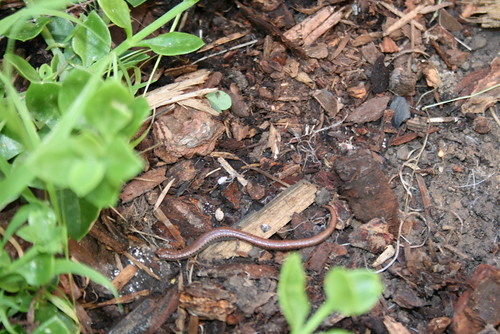
Sunday was such a nice day outside, we decided to go and do some gardening in the backyard. Over the winter, clovers started taking over the yard. In northern California, the weeds that tend to grow like crazy don't actually look like weeds at first. They look like clovers and after a while, they sprout such pretty yellow flowers. They aren't that ugly in general, but the problem is that they take over and block light and valuable nutrients and water from the other plants. We let the clovers grow a while, but decided that now was the time to rip them out since it would not rain for much longer here and the clovers were going to die soon anyways naturally. While we were gardening we discovered a salamander under a clay pot which had an evergreen bush in it. It was hiding out under the pot where it was cool and damp. The salamander was a California Slender Salamander, and during the winter, it is active and tunnels its way underground, sheltered in tunnels dug by other creatures like earthworms or termites. During the summer dry months, it hibernates. There is a special word for hibernation during the summer; it is called aestivation. It has no lungs, so it breathes through its skin. Oxygen is transported into the blood through diffusion into capillaries located close to the skin's surface instead of lungs. When I first moved the big clay pot, I thought it was a baby snake, but then it started to move and the head looked different and then I saw that it had four tiny tiny tiny legs! Romy tried to pick it up, but he couldn't catch it. It slithered away to another secret hiding spot.

Salamander
A California Slender Salamander in our backyard.

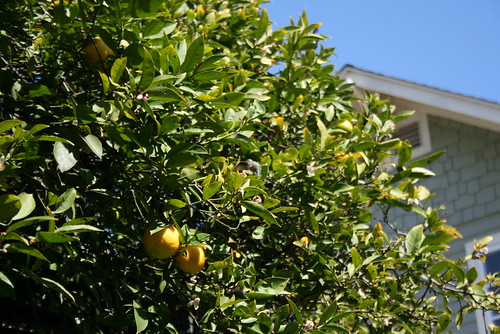
While we were out ripping clovers, we saw the hummingbird which visits regularly in the lemon tree. It is really tiny and has a metallic purplish blue coat of feathers. The wings beat so fast you can't see them, so it looks like a bird body with a long beak flying around and hovering from flower to flower in the tree. Depending on the species, the wings beat between 19-90 times per second, and they are the only bird that is able to fly backwards! It wasn't too afraid of us, because we walked up to it to get a better look and it just kept flying around looking for citrus flowers.

Hummingbird
A hummingbird visited the lemon tree in our backyard. It is hard to see the hummingbird, but it is exactly in the center of the picture. Click on the picture to see it better.

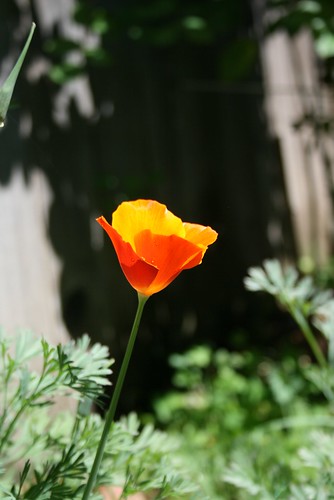
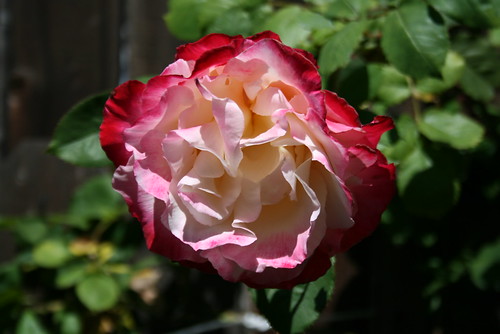
Also, the poppy flowers we planted in October are growing big and the first poppy flower bloomed this past weekend. The seed package showed red poppies, but the poppy that bloomed was orange, like all of the wild ones you see growing everywhere here in California. Poppies are my favorite flower, so I was happy to see that they just started blooming! The two rose bushes in the backyard are also blooming like crazy. One of them bloomed a neon rose. The color is so intense, its almost luminescent! All the herb-y type plants are also very fragrant, so it seems as if the entire bay area is an herb garden. I regularly smell sage, rosemary, and bay leaf everyday in the air. Not to mention the fresh eucalyptus scent from the trees.

First Poppy
The first poppy flower to bloom in our backyard. We planted the seeds back in October.

Neon Rose
The neon rose.

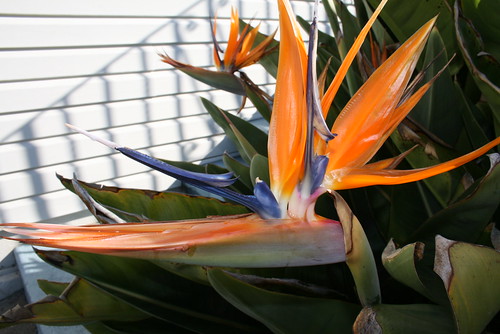
Bird of Paradise
We also have bird-of-paradise flowers in the front of our duplex. They have been blooming all winter, during the rainy season.